



Summary
Workflow automation is the practice of intentionally designing how work moves from trigger to outcome across systems and teams. By clearly defining logic, actions, and exception handling, organizations reduce repetitive tasks at scale and allow common work to progress without constant oversight. The real value is not just speed but focus, creating capacity for higher impact initiatives and strategic thinking. Artificial intelligence can enhance certain workflows, such as data extraction or classification, but it is not required for success. Strong automation is built on structure and clarity first, with AI added only where it meaningfully improves the flow.
Automation has become one of those words that sounds powerful but rarely means the same thing twice.
For some teams, it is a script written years ago that everyone hopes keeps running. For others, it is a handful of integrations meant to shave a few minutes off a task. More recently, automation has become almost interchangeable with AI, as if intelligence is the defining feature.
Workflow automation is not defined by how advanced it sounds. It is defined by how clearly work moves.
At its core, workflow automation is the practice of designing how information travels from trigger to outcome across tools, people, and decisions with as little friction as possible.
When done well, it removes repetitive work, reduces ambiguity, and gives people space to focus on larger, more meaningful initiatives.
That shift in focus is where the real value lives.
What a Workflow Actually Is
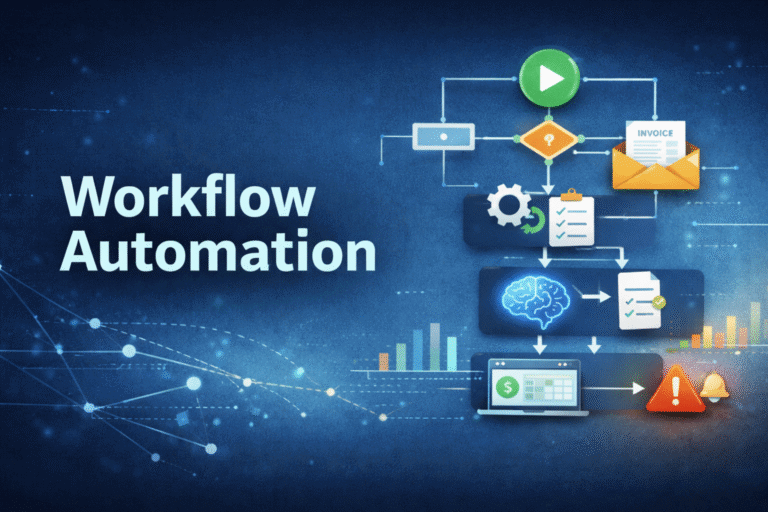
A workflow is a repeatable path from input to outcome.
Every strong workflow includes four elements:
- Trigger: Something happens, either an event or a scheduled action.
- Logic: Decisions determine what happens next.
- Actions: Systems or people execute the steps.
- Exceptions: Edge cases and errors are handled intentionally.
When these four elements are designed explicitly, repetitive tasks begin to disappear in a meaningful way. Not just one at a time, but across the entire process.
The goal is not simply to automate isolated tasks.
It is to remove low value, repeatable effort so people can invest their energy in judgment, creativity, strategy, and relationship building. The work automation should support, not replace.
A Simple Example (That Rarely Stays Simple)
Imagine a vendor invoice arrives by email.
It sounds straightforward:
- Trigger: Invoice received.
- Action: Upload to accounting software.
But real world decisions appear immediately:
- Is the invoice complete and valid?
- Is it a duplicate?
- Does it match an approved purchase order?
- Who needs to review it?
- Is it urgent?
Without explicit logic, those decisions are handled informally. Someone checks it. Someone forwards it. A Slack message clarifies something. A follow up happens later.
The automation runs. People still carry the cognitive load.
A designed workflow makes the decision making visible:

Now the repetitive review steps are structured. The common cases move forward automatically. Humans step in only where judgment is actually required.
That is what truly frees up time. Not just speed, but selectivity.
Where AI Fits and Where It Does Not
Some workflows benefit from AI.
- If invoices need data extracted from PDFs, AI can read and structure that information.
- If support tickets need categorization, AI can assist with classification.
- If documents need summarizing before review, AI can prepare context.
In these cases, AI becomes a component inside the workflow, usually within the logic or action layer.
But many effective workflows do not require AI at all. Routing approvals. Syncing systems. Checking duplicates. Sending notifications. Updating records. Enforcing timelines. These are structural challenges, not intelligence problems. AI can enhance a workflow but it is not a requirement for one.
Strong automation starts with clarity and structure. Once the flow is well designed, it becomes obvious where AI adds value and where it simply adds complexity.
The Pattern Shows Up Everywhere
The same dynamic appears across departments. Take new employee onboarding.
On paper:
- Trigger: Start date confirmed.
- Action: Create accounts and send welcome materials.
In practice:
- What tools does this role need?
- Who approves access to sensitive systems?
- What happens if the start date changes?
- How do HR, IT, and the hiring manager stay aligned?
Without a designed workflow, onboarding becomes a checklist passed around through email and Slack. Steps are repeated. Information is re-entered. Follow-ups are manual.
With a structured workflow:

Account creation becomes standardized. Approvals follow defined rules. Notifications happen automatically. HR and IT spend less time chasing tasks and more time improving the employee experience itself.
Different department. Same pattern.
Automation Amplifies What Already Exists
Automation executes whatever process already exists. If the process is unclear, automation will execute that confusion consistently. If the outcome is not defined, automation will move quickly but not necessarily correctly.
That is why workflow automation begins with clarity:
- What outcome are we driving toward?
- What decisions shape that path?
- Where does human judgment truly add value?
- Which repetitive steps can be safely systematized?
When those answers are explicit, repetitive work shrinks. Cognitive load drops. Teams stop spending energy on coordination and start spending it on progress.
The Real Goal of Workflow Automation
Reduce bottlenecks, eliminate repetitive tasks, improve productivity.
Well designed workflows reduce repetitive tasks at scale. They eliminate unnecessary back and forth. They make common cases move forward without supervision. The result is not just efficiency. It is capacity.
Capacity for larger projects.
Capacity for strategic thinking.
Capacity for work that requires creativity and human insight.
The best automations rarely feels flashy. They work in the shadows. A reliably predictable helper that allows people to do what they best.
If you would like to learn more about workflow automation or if you have processes you’d like to explore automating, contact Arc Intermedia to explore what automations can do for your business.


