




Long before the rest of the industry caught up, Arc Intermedia tested and perfected a form of GEO and AEO to ensure client visibility across AI answer engines and LLMs.
In a search environment where research extends beyond a company’s website and narratives form independently from typical marketing tactics, our unified approach ensures brands are seen, understood, and preferred. Arc’s proven methodology transforms complexity into clarity and visibility into measurable growth.

Digital marketing is a business investment and must produce real returns. It’s what our clients expect. It’s what we deliver.
Client Revenues

Transactions & Leads
Website Visitors




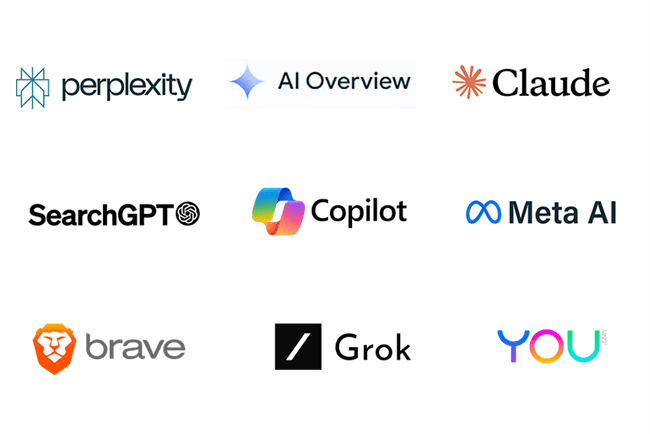

Arc’s specialized process establishes clear authority across advanced discovery models.

A rigorous and thoroughly tested methodology to feed and influence LLMs to secure direct brand citations.
Aligning on-site data architecture and technical signals to ensure LLMs crawl, interpret, and synthesize core content assets.
Deploying precise, query-focused database modules and semantic schema that voice assistants and direct-answer engines can extract.
Brand reference points and technical validation metrics across external authorities compel AI citations.
Leveraging the latest advances in AI prompt and citation tracking ensures results are reported as well as technically possible.
Certifications, continuing education, platform partnerships, and top tech tools aren’t just perks. At Arc Intermedia, they are requirements and our clients are the beneficiaries.
















Call 610.347.5661 or fill out this form to get started.
Are GEO, AEO, and SEO different? Do you need them all? Does it replace other digital marketing efforts?
Here are important answers to commonly asked questions about the current state of search:
GEO (Generative Engine Optimization) focuses on optimizing content structure and authority signals so LLMs utilize and cite a brand in conversational, synthesized summaries. AEO (Answer Engine Optimization) structures content to directly solve specific questions, feeding direct-response frameworks like voice search and zero-click snippets.
Advanced tracking methodologies monitor Share of Voice across major LLMs, including ChatGPT and Gemini. Measurement focuses on how frequently a brand is recommended for industry queries, the sentiment of the AI response, and the inclusion of direct citations and hyperlinks back to corporate digital properties.
Not automatically. Traditional SEO targets keyword density and backlink volume, whereas LLMs demand semantic completeness, structured data, and high-trust data citations. Existing content assets must be re-engineered to utilize conversational data structures and direct-answer frameworks that AI engines easily synthesize.
Real-time answer engines and active web-crawling models reflect on-site optimizations within days. Conversely, core LLMs relying on periodic training datasets experience visibility shifts as new model iterations are released and external citation strategies gain traction.
No, the program optimizes concurrently. Traditional search engines continue to drive massive traffic pipelines, and AI engines rely heavily on traditional SEO signals, such as crawlability and domain authority, to discover content. This integrated approach preserves market share as user habits shift from keyword queries to AI-driven conversations.