


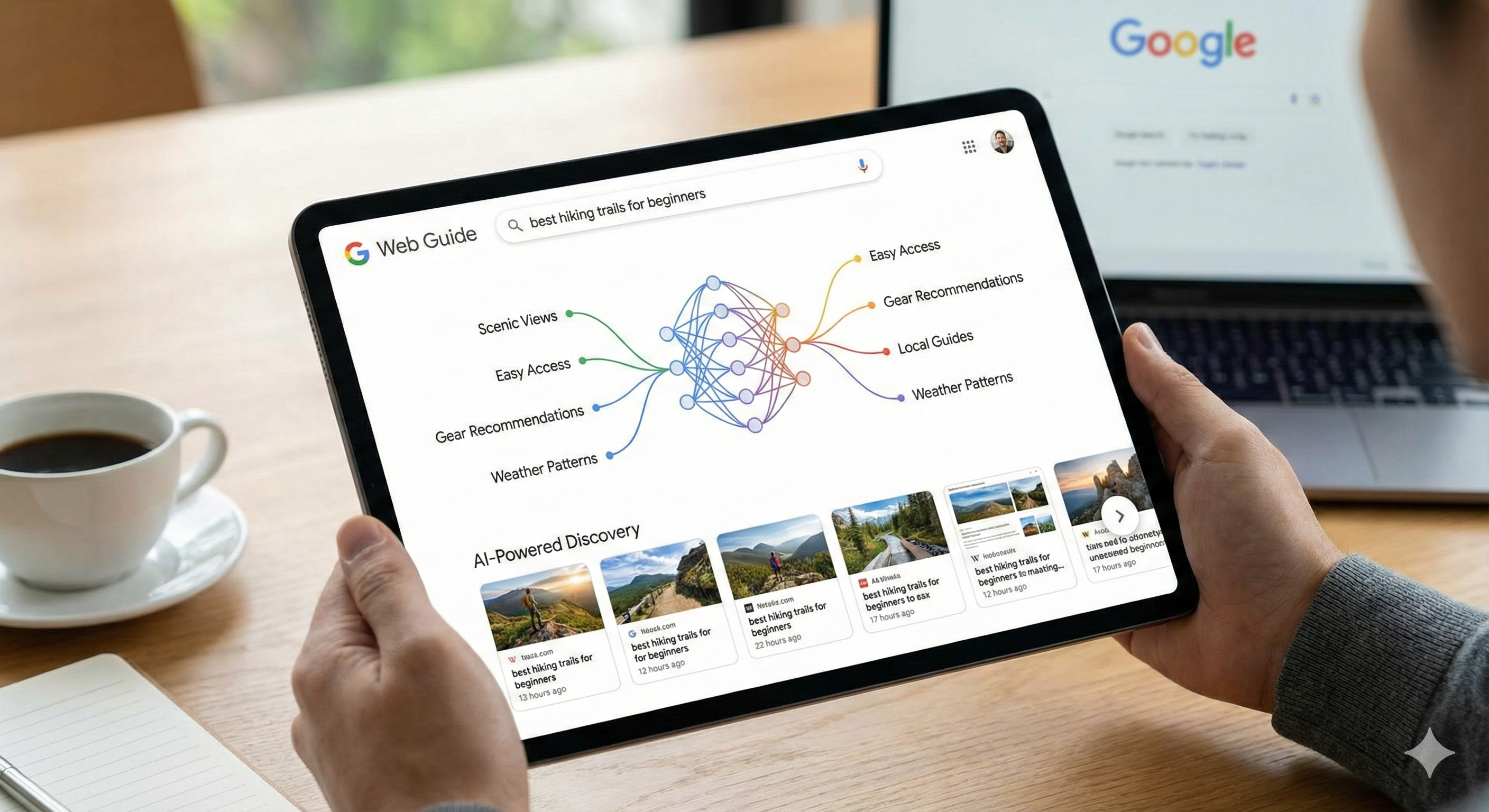

What is Web Guide?
Web Guide is an experimental search-feature from Google, currently available under Search Labs.
In short: instead of a plain list of “10 blue links,” Web Guide uses artificial intelligence (AI) to reorganize search results into topic-based clusters. When you type in a query – especially an open-ended, detailed, or multi-part question – Web Guide leverages a custom version of Gemini AI to:
- Understand the full meaning and intent behind your query, not just keyword matches.
- Simultaneously launch multiple related sub-searches (“query fan-out”) to surface a wide array of potentially relevant pages across different angles/topics.
- Organize the results into clusters, each focusing on a different facet or subtopic related to the original query, with headings, sections, and sometimes short summaries.
- Let users browse content more thematically, rather than scroll through a long list of mixed relevance.
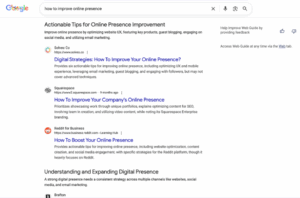
For example: a query like “how to improve online presence” might yield clusters like “actionable tips,” “understanding digital presence,” “website seo and search visibility,” “content marketing,” “online presence tools,” etc.
A complex, multi-sentence query like “Our website traffic has been steady, but conversions are dropping. What steps should we take to identify the problem, understand user behavior, and choose the right tools to improve performance?” might be broken down into clusters such as “conversion rate diagnostics,” “user behavior analytics,” “A/B testing strategies,” “landing page optimization tactics,” “tools for CRO and heatmapping,” and “best practices for improving on-site engagement.”
That makes Web Guide something between traditional search results and a more guided research assistant, not quite a full AI-generated answer (like a chatbot), but more structured than a flat list.
As of now, it’s opt-in. Users can enable it via Search Labs and toggle between Web Guide view and standard results. The feature currently appears under the “Web” tab of Google Search, although google has indicated they may expand its presence over time.
Why Web Guide Matters: What It Signals About the Future of Search
A shift away from the “10 blue links” model
For decades, search engines presented results as a ranked vertical list, often known as the “10 blue links.” Web Guide challenges that paradigm. Its AI-powered clustering could change how users browse the web, making research more about exploring themes than scanning pages. That has major implications: it could change which pages get clicks, how users discover content, and how they navigate complex topics.
Smarter query understanding and context awareness
Because Web Guide (via Gemini) tries to understand the semantics and intent behind queries, it offers a more “human-like” search experience. This reflects an evolution: search engines increasingly see their mission as not just finding pages, but curating knowledge.
An “answer engine + discovery engine” hybrid
Web Guide is part of a broader trend by Google: combining classic link-based search with AI-powered summarization and guidance (features like AI Overviews, AI Mode, etc.). In effect, Google is positioning itself as not only a portal to the web, but a kind of guide, helping users explore and understand complex queries in depth.
Impact on content discovery and attention flows
Because Web Guide clusters content by theme, users might land on pages they otherwise would not see, perhaps less popular or deeply buried resources. That could democratize content discovery in some sense, giving higher visibility to niche, helpful, or long-tail content. Conversely, it may reduce the dominance of high-ranking pages in traditional search results, redistributing attention across a wider range of sources.
How Web Guide Can Inform Digital Marketing & SEO Strategy
Web Guide reshapes how information is organized and discovered. Here’s what marketers should focus on:
1. Build Topical Authority (Not Just Single Pages)
- Web Guide groups results by themes, so interconnected, high-quality pages improve your chances of appearing in multiple clusters.
- Cover broader subjects with depth, include how-tos, comparisons, FAQs, and supporting resources.
- Use pillar + cluster structures to signal expertise across an entire topic, not just one keyword.
2. Target Long-Tail and Complex Queries
- Web Guide thrives on multi-part, exploratory questions, build content that answers nuanced, layered queries.
- Write in natural, question-friendly language that mirrors conversational searches.
- Ensure content is comprehensive and well-organized, making it easy for AI to identify subtopics.
3. Diversify Content Types and Formats
- Because Web Guide can surface less obvious sources, niche or lower-authority pages may perform well if the content is strong.
- Go beyond blog posts: create guides, FAQs, deep dives, case studies, and data-driven content.
- Strengthen internal linking to help AI understand connections across your site, boosting visibility in clusters.
4. Rethink Paid Search & Traffic Expectations
- Clustering may change how users interact with results, impacting CTR patterns for both organic and paid listings.
- PPC campaigns may benefit from informational assets that align with early-stage research, not only transactional pages.
- Strong organic topical coverage can capture users earlier in the funnel and support downstream conversions.
5. Monitor Evolving SEO Signals & SERP Behavior
- Traditional SEO signals may shift in weight as AI emphasizes topical relevance, clarity, and depth.
- Compare performance in Web Guide vs. standard search to identify traffic changes or new opportunities.
- Expect both visibility boosts for well-structured content and traffic redistribution for sites relying solely on top rankings.
Challenges, Risks & Things to Watch Out For
While Web Guide offers promise, it’s not a silver bullet, and there are several caveats:
- It’s experimental: Web Guide is still a labs experiment. Google may change it dramatically, limit it, or even retire it, so it’s wise not to overhaul your entire content strategy based solely on it (yet).
- AI mistakes & biases: As with all AI-driven summarization / categorization, there’s a risk that Web Guide mis-interprets queries, mis-categorizes, or surfaces misleading or low-quality content. Google itself warns it “may make mistakes.”
- Uncertain impact on traffic & monetization: For publishers, the shift in how people find content could harm traditional traffic models, especially if users consume summaries or grouped content without clicking through. Indeed, some publishers fear “traffic cannibalization.”
- Need for robust content structure: To succeed under Web Guide’s logic, content must be well-organized, comprehensive, and thoughtfully linked, which may require extra content planning, updating, and maintenance.
What Marketers & SEO Professionals Should Do Today
Given Web Guide’s emergence, here are practical recommendations for marketers, content creators, SEO pros, and digital strategists:
- Experiment now, but cautiously. If you have access to Web Guide, try searching queries related to your niche. Observe how clusters are structured, which kinds of content Google surfaces, and where your content fits (or doesn’t).
- Build topic clusters, not just individual pages. Structure content around themes and subtopics. Use internal linking to connect related pieces. Prioritize long-form, in-depth, well-structured content that addresses many facets of a topic.
- Use natural language and audience-focused questions. Write content that answers real user questions, including multi-part queries, follow-up questions, FAQs. Think beyond keywords.
- Diversify content formats. Include guides, how-to’s, comparisons, case studies, not just blog posts. Consider multimedia, structured data, but also clarity and readability.
- Monitor performance and traffic flow carefully. As Web Guide and other AI-search features roll out, track how traffic sources change. Evaluate performance not just in terms of pages ranking, but how users navigate, engage, and convert.
- Stay adaptive. The search landscape is shifting fast. What works today might need tweaking tomorrow. Keep testing, iterating, and adjusting.
A Glimpse into the Next Era of Search
Web Guide suggests that search’s future may be less about sorting by “relevance score + backlinks” and more about organizing by meaning, intent, and context. For marketers, publishers, and content creators, that means adapting: building content that’s not just optimized for algorithms, but genuinely helpful and comprehensive from a user’s point of view.
If Web Guide becomes mainstream, it could reshape how content is discovered and valued, rewarding topical depth, clarity, and breadth over traditional SEO tricks. Although it’s still experimental, forward-looking teams should start thinking now about how to align with this potential future.


