


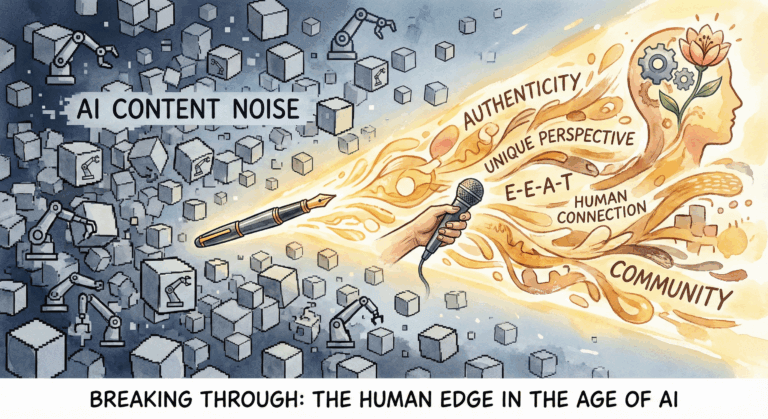

The digital information ecosystem of 2025 is characterized by a fundamental inversion of scarcity. For the first two decades of the internet, the primary constraint was production—the resources, talent, and time required to create high-fidelity content. Today, generative artificial intelligence (GenAI) has effectively reduced the marginal cost of content creation to zero. As of early 2025, 78% of organizations have integrated AI into their business functions, and content saturation has reached unprecedented levels, with media companies and advertisers competing for a biologically fixed cap of approximately six hours of daily consumer attention.
This transition from the Information Age to the Intelligence Age has precipitated a crisis of signal-to-noise. The digital environment is flooded with synthetic media, creating a “noise floor” that drowns out traditional brand messaging. Furthermore, the very architecture of discovery is shifting. Search engines, the gatekeepers of the web for twenty years, are evolving into “Answer Engines” powered by Large Language Models (LLMs), fundamentally altering the mechanics of visibility. Simultaneously, human audiences are retreating from the algorithmic chaos of the public web into “dark social” enclaves, seeking authenticity, verified human connection, and “unpolished” reality.
This report provides a comprehensive analysis of this new landscape. It argues that breaking through the noise requires a radical bifurcation of strategy: brands must optimize technically for the machine agents that now mediate discovery (Generative Engine Optimization), while simultaneously investing in deeply human, emotional, and verifiable content experiences that AI cannot replicate (Radical Authenticity). Through an examination of over 150 data sources, case studies from Heinz, Patagonia, and HubSpot, and emerging technical standards like C2PA, this document outlines the operational roadmap for the “Barbell Strategy”—the necessary fusion of high-tech efficiency and high-touch humanity required to survive in 2025.
1. The Saturation Crisis: The Economics of Infinite Content
The content landscape of 2025 is not merely crowded; it is approaching a state of theoretical maximum density. The democratization of generative AI tools has decoupled content volume from human labor constraints, leading to an exponential surge in digital assets. This phenomenon, often termed “content inflation,” has profound economic and strategic implications for organizations attempting to maintain market share.
1.1 The Velocity of Production and the Attention Ceiling
The widespread adoption of generative AI has catalyzed a production boom without historical precedent. Statistics indicate that 92% of students and 51% of marketers are now utilizing GenAI tools regularly. In the B2B sector, adoption has reached 81%, a significant increase from 72% the previous year. This ubiquity of tooling means that a single marketing operator can now produce volume that previously required a fully staffed editorial team. However, this supply-side explosion faces a hard demand-side constraint: human attention.
Research from Deloitte highlights that consumers have a finite capacity for media consumption, capped at an average of six hours per day. This biological limit creates a zero-sum game. Every new piece of AI-generated content entering the ecosystem increases the “cost” of acquiring attention for every other piece of content. The result is a dramatic erosion of organic reach and a skyrocketing cost per acquisition (CPA) on paid channels. The market is witnessing the commoditization of information; when the supply of “how-to” guides, listicles, and generic blog posts becomes infinite, their market value drops to near zero.
This saturation is not uniform across all formats. While text generation has become trivial, high-fidelity video and interactive 3D content still retain some barriers to entry, though these too are eroding. The primary consequence for marketers is that the “more is better” strategy—the volume-based SEO playbooks of the 2010s—is now actively detrimental. Flooding the zone with mediocrity simply adds to the noise, training audiences to filter out the brand as spam.
1.2 The “Model Collapse” and Content Homogeneity
A second-order effect of this saturation is the homogenization of digital discourse. As marketers rely on the same foundational models (GPT-4, Claude 3, Gemini) to generate content, the outputs inevitably regress toward the mean. These models function by predicting the most probable next token, effectively acting as consensus engines. They excel at summarizing existing wisdom but struggle to generate the “spiky,” contrarian, or novel insights that arrest human attention.
This phenomenon, described as “content slop” or “model collapse,” creates a landscape of digital sameness. Brand voices lose their distinctiveness, as marketing copy begins to sound like it was written by a committee of algorithms. The “flattening” of nuance means that differentiated points of view (POV) are more valuable than ever, yet harder to find. Brands that rely solely on AI for ideation and drafting risk becoming invisible, not because they aren’t publishing, but because they sound exactly like everyone else.
1.3 The Trust Deficit and Synthetic Skepticism
Perhaps the most damaging consequence of the AI age is the erosion of trust. The ease with which deepfakes, hallucinations, and synthetic fabrications can be produced has instilled a deep-seated suspicion in audiences. This “synthetic skepticism” means that high-polish content, once a signal of authority and budget, is now often viewed as potentially fake.
The implications for brand authority are severe. If a consumer cannot verify whether a testimonial, a product image, or a CEO statement is real, they default to distrust. This has birthed a new consumer demand for “provenance.” Audiences are actively seeking signals of verification—evidence that a human was involved in the creation process. This shift is driving the adoption of technical standards like the Coalition for Content Provenance and Authenticity (C2PA) and the “Content Credentials” pin, which serve as a digital “nutrition label” for media, verifying its origin and edit history.
Furthermore, this trust deficit is reshaping the regulatory landscape. In jurisdictions like California, legislation such as AB 3211 now mandates that large online platforms apply labels to disclose the provenance data found in watermarks of AI-generated content. For global brands, compliance with these transparency standards is becoming a requisite component of content strategy, moving from a “nice-to-have” to a legal and reputational necessity.
2. The Technical Pivot: From SEO to Generative Engine Optimization (GEO)
For twenty years, “breaking through the noise” meant ranking on the first page of Google. In 2025, that paradigm is being dismantled. The transition from Search Engine Optimization (SEO) to Generative Engine Optimization (GEO) represents the most significant technical disruption in the history of digital marketing. Search engines are evolving into “Answer Engines,” where the goal is no longer to route traffic to a website, but to synthesize a direct answer for the user.
2.1 The Mechanics of Visibility in the Age of Answer Engines
Traditional SEO was built on the concept of “ten blue links.” Users would query a keyword, and the search engine would act as a librarian, pointing them to relevant resources. Answer engines, powered by Retrieval-Augmented Generation (RAG), act as analysts. They read the resources, synthesize the information, and present a single, consolidated response. Platforms like Perplexity, SearchGPT, and Google’s AI Overviews have fundamentally changed the user journey.
Data indicates that when an AI Overview is present, click-through rates (CTR) on traditional organic results drop by approximately 34.5%. More alarmingly for legacy SEOs, there is a low correlation between traditional rankings and AI citations; the overlap between pages that rank #1 in search and sources cited by AI is less than 20%. This means that a brand can be the top search result and yet be completely invisible in the AI-generated answer that the user actually reads.
To survive in this environment, content must be optimized for “ingestion” rather than just “indexing.” The AI needs to be able to extract facts, entities, and relationships from the content to construct its answer. This requires a shift from keyword-stuffing to “Answer Nugget Density”—the frequency of clear, concise, and definitive statements that directly address user queries.
2.2 Structural Requirements for AI Comprehension
Research into GEO suggests that LLMs favor specific content structures that mirror the “inverted pyramid” style of journalism. Content that front-loads the answer, followed by supporting data and context, is more likely to be cited than content that buries the lead behind storytelling or marketing fluff.
The following table contrasts the traditional SEO approach with the emerging GEO playbook, highlighting the necessary strategic pivots.
| Optimization Factor | Traditional SEO Strategy (2010-2023) | Generative Engine Optimization (GEO) Strategy (2025+) |
| Primary Objective | Rank URL in Top 3 search positions | Secure citation/mention in AI-generated answer |
| Success Metric | Organic Traffic, CTR, Bounce Rate | Share of Voice in Answers, Citation Frequency |
| Content Structure | Long-form, narrative, “retention” focused | Fact-dense, structured, “ingestion” focused |
| Keyword Strategy | Exact match and semantic variations | Natural language questions and entity relationships |
| Authority Signal | Backlinks from high Domain Authority sites | Brand mentions, sentiment, and cross-platform corroboration |
| Technical Focus | Core Web Vitals, Mobile Usability | Schema markup, llms.txt, Entity definitions |
| Freshness | Evergreen content preferred |
Actionable GEO Tactics:
Quote-Ready Syntax: Brands must write sentences that are ready to be quoted. For example, instead of a vague “We saw significant growth,” write “Company X achieved a 35% reduction in fraud within 12 months.” AI models look for these distinct data points to anchor their generated responses.
Statistic Freshness: Answer engines prioritize the most current information to avoid hallucinations. Updating core pillar pages with new statistics, dates, and examples every 90 to 180 days is a critical lever for maintaining visibility in Perplexity and Google AI Overviews.
Entity Mapping via Schema: Brands must use Schema.org markup to explicitly define their organization, products, and authors as “entities.” This helps the AI understand the semantic relationships between the brand and specific topics, moving beyond simple keyword matching to “topical authority”.
2.3 The Gatekeeper Bots and the llms.txt Standard
A critical, often overlooked aspect of the technical shift is the role of web crawlers and permissions. The robots.txt file has evolved from a simple directive for search engine spiders to a strategic filter for AI agents. Brands must decide which AI models they allow to “read” their content. Blocking bots like GPTBot or CCBot protects intellectual property from being used to train models without compensation, but it also risks removing the brand from the “memory” of these systems, potentially rendering it invisible in future customer queries.
For B2B brands, where the sales cycle often involves research via AI agents, visibility is paramount. Emerging standards like the llms.txt file—a directory specifically designed to help LLMs navigate and understand site structure—are becoming best practices for “agent-friendly” websites. This file acts as a map for the AI, pointing it directly to the most important, fact-checked, and valuable content on the domain, ensuring that when the AI answers a question about the brand, it uses the brand’s own data rather than third-party hearsay.
3. Reclaiming Authenticity: The Human-Centric Imperative
As the marginal cost of producing “average” content drops to zero, the value of “authentic” content skyrockets. In an ecosystem flooded with synthetic perfection, human imperfections—the shaky camera, the unscripted pause, the raw opinion—become premium signals of trust. This “flight to reality” is driving a massive cultural shift toward “human-centric” marketing.
3.1 The “No-Edit” Trend and Lo-Fi Marketing
Counter-intuitively, as AI tools enable Hollywood-level production quality on a laptop, engagement metrics are shifting toward “lo-fi” and “no-edit” content. Audiences, particularly Gen Z, have developed a sophisticated radar for over-production, associating it with manipulation and advertising. In contrast, content that appears raw and unfiltered feels “real” and therefore trustworthy.
This trend helps explain the explosive growth of formats like “Get Ready With Me” (GRWM) or “Day in the Life” videos, where the aesthetic is intentionally casual. Brands like Chipotle and Duolingo have capitalized on this by producing content that feels native to the platform—often shot on mobile devices with minimal post-production—rather than repurposing glossy TV commercials. This “lo-fi” approach serves as a “Proof of Humanity.” In an era where an AI can generate a photorealistic image of a product, a grainy video of a real customer holding that product carries significantly more evidentiary weight.
Operationalizing this requires brands to relax their brand guidelines regarding “polish.” The goal is not perfection, but connection. The “Choose One” challenges and interactive polls dominating Instagram in 2025 thrive because they invite human agency and participation, something AI content cannot authentically replicate.
3.2 Point of View (POV) as a Competitive Moat
Information is a commodity; a Point of View (POV) is a proprietary asset. AI models are designed to be helpful, neutral, and consensus-driven. They struggle with contrarianism, strong opinions, and unique perspectives. Therefore, content strategy must pivot from “explaining topics” (which AI does better) to “taking a stand on topics” (which only humans can do).
Developing a strong POV requires a departure from safe, neutral corporate speak. It involves interpreting facts through the lens of specific brand values and experiences.
The POV Framework:
Opinion over Fact: Do not just report the news; interpret it. What does this development mean for the specific reader? Why does it matter?
Experience Integration: POV content must be rooted in first-hand experience. “I tried X and here is what happened” is infinitely more valuable than “What is X.” AI can describe a strategy; a human can describe the pain of implementing it.
Vulnerability: Admitting failure or uncertainty builds rapport. AI rarely admits doubt unless programmed to; humans do it naturally. Sharing “lessons learned from failure” is a powerful way to demonstrate authenticity.
3.3 E-E-A-T: Experience as the New “E”
Google’s update to its Quality Rater Guidelines, changing E-A-T to E-E-A-T by adding “Experience,” codifies the human advantage. Algorithms now explicitly reward content that demonstrates “first-hand or life experience”. This is a direct countermeasure to AI-generated content, which can possess “Expertise” (access to data) but cannot possess “Experience” (living through an event).
To operationalize E-E-A-T in 2025, content must include explicit authorship signals. Every piece of content should be linked to a verifiable human author with a bio, social footprint, and credentials. Visual proof is also essential; using original photos of the author or team interacting with the subject matter creates a “trust anchor.” Stock photography and AI-generated imagery, conversely, weaken the “Experience” signal and can trigger the “synthetic skepticism” filter.
4. Operationalizing the Strategy: Agentic Marketing and B2B
While human authenticity wins hearts, technical efficiency wins workflows. The rise of “Agentic AI”—systems that can autonomously perceive, reason, and act—is transforming the B2B marketing funnel. The customer journey is no longer a linear path of human clicks; it is a complex web of interactions between human buyers and their AI agents.
4.1 The Rise of the Machine Buyer
By 2025, it is estimated that up to 20% of organic traffic will originate from AI agents acting on behalf of buyers. A procurement manager might task an AI agent to “Find the top three CRM systems for a mid-sized healthcare company and compare their security compliance.” The agent crawls the web, parses pricing pages, reads whitepapers, and presents a summary. In this scenario, the brand never “sees” the human until the final selection.
This reality necessitates a “Machine-First” content strategy alongside the human one. Websites must be optimized to sell to a robot. This means removing friction for crawlers: clear pricing tables (no “contact us for quote” barriers that confuse bots), explicitly stated compliance standards (SOC2, HIPAA) in plain text, and fast load times. If an agent cannot easily extract the price and features, the brand will simply be excluded from the consideration set presented to the human decision-maker.
4.2 Agentic Content Workflows
Internally, high-performing marketing teams are using Agentic AI to redesign their workflows. Rather than using AI merely to write blog posts, they are deploying agents to handle entire segments of the funnel. AI agents can now qualify leads, personalize outreach sequences based on real-time data, and even negotiate scheduling.
The “Agentic Content” strategy involves creating modular content assets—data points, customer stories, value propositions—that the AI agent can assemble on the fly to create a highly personalized message for a specific prospect. This moves marketing from “broadcast” mode (one message to many) to “conversation” mode (unique messages to each, at scale).
5. Community Architecture: The Owned Channel Defense
The volatility of third-party platforms—whether through algorithmic shifts or the rise of AI search—has made “rented land” a dangerous foundation for a business. The strategic response is a shift toward “Community Architecture,” focusing on building owned, direct channels of communication that are resilient to external disruption.
5.1 The Flight to Dark Social
“Dark social” refers to private channels like WhatsApp, Discord, Slack, and email, where content is shared privately rather than on public feeds. As the public web becomes noisier, real influence is migrating to these high-trust, low-noise spaces. Brands are responding by creating their own private communities.
The debate between platforms like Circle and Discord illustrates the diverse needs of these communities.
Discord is favored for high-energy, real-time engagement, making it ideal for B2C, gaming, and Web3 brands. However, its chaotic nature can lead to burnout.
Circle offers a more structured, “calm” environment, better suited for B2B, education, and creator economy brands that want to host courses, content, and discussions in a branded, white-label environment.
5.2 The Newsletter Economy and Substack
Newsletters remain the most resilient “owned” channel. However, the newsletter of 2025 is not just a distribution list; it is a social network. Platforms like Substack have introduced features like “Notes” and chat, transforming newsletters into interactive communities. The key to success here is voice. Successful newsletters function like magazines with a distinct editor-in-chief persona. They curate the chaos of the web, providing a filtered, human perspective that subscribers trust. Strategies for 2025 include personalized welcome emails (the highest open-rate email) and integrating audio/video directly into the inbox to deepen the connection.
5.3 Co-Creation with the Creator Economy
The “Influencer” model is evolving into a “Creator-Partner” model. Brands are moving beyond simple sponsored posts to deep co-creation relationships. This leverages the creator’s established trust and community to bypass the skepticism directed at corporate advertising. “Micro-influencers” and User-Generated Content (UGC) creators are particularly effective because their smaller, tighter communities view them as peers rather than celebrities. This peer-to-peer recommendation engine is a powerful antidote to the “dead internet” feeling of AI-generated reviews.
6. Case Studies: Strategic Brilliance in the Age of AI
Examining how leading brands are navigating this landscape provides concrete examples of the “Technical Efficiency + Radical Authenticity” framework in action.
6.1 Heinz: Creativity Over Technology
The Challenge: How does a legacy condiment brand maintain cultural relevance in a tech-obsessed world?
The Strategy: Heinz launched a campaign using OpenAI’s DALL-E 2. Instead of using AI to replace their creative team, they used it to prove their brand dominance. They asked the AI to “draw ketchup,” and the model consistently generated images that looked like the iconic Heinz bottle.
The Insight: This was a masterclass in using AI as a cultural mirror. It wasn’t about the technology itself, but about the human recognition that “ketchup = Heinz.” By inviting fans to submit their own prompts, they turned a solitary AI activity into a communal, social event, generating 850 million earned impressions.
Takeaway: Use AI to reinforce your brand’s human connection, not just to cut costs.
6.2 Dove: Values-Driven Technology
The Challenge: Dove sought to expand its “Real Beauty” mission into the gaming world, a space often criticized for lack of diversity.
The Strategy: They launched “Code My Crown,” a massive educational initiative and a 200-page technical guide for game developers. The guide, created in partnership with Black 3D artists, provided the code and meshes necessary to realistically render Black hairstyles in video games.
The Insight: Instead of a superficial ad campaign, Dove created a utility that solved a complex technical problem (rendering textured hair) while advancing a deeply human cause (representation). This reinforced their E-E-A-T signals (Expertise in beauty, Authoritativeness in inclusivity) and built immense trust.
Takeaway: Build tools that help your community express their identity.
6.3 Patagonia: The Anti-Algorithm Brand
The Challenge: Growing a retail brand while maintaining a strict commitment to anti-consumerism and sustainability.
The Strategy: Patagonia doubles down on “slow content”—long-form documentaries, essays, and the “Worn Wear” program which encourages repairing gear over buying new.
The Insight: By rejecting the “churn” of daily trend-jacking, Patagonia signals extreme authenticity. Their content is mission-critical, not algorithm-critical. This builds a cult-like community that acts as a defensive moat against competitors. When a brand tells you not to buy their product, you trust them more when they say a product is good.
Takeaway: Authenticity often means doing the opposite of what the “growth hacks” dictate.
6.4 HubSpot: The Hybrid Model
The Challenge: As a B2B platform, how to integrate AI without losing the “inbound” philosophy of human helpfulness.
The Strategy: HubSpot’s “Fall 2025 Spotlight” and “Breeze” AI focus on hybrid teams. They frame AI not as a replacement for marketers, but as an enabler that removes drudgery so humans can focus on strategy.
The Insight: Their content strategy emphasizes “smart people + smart systems = growth.” By positioning themselves as the ethical, human-centric AI platform, they differentiate from competitors who push pure automation.
Takeaway: Position AI as a tool for human empowerment, not human replacement.
6.5 Starbucks: Deep Brew and the Siren System
The Challenge: Personalizing the experience for millions of daily customers while optimizing complex supply chains.
The Strategy: Starbucks utilizes its “Deep Brew” AI platform to drive personalization in its app, suggesting orders based on weather, time of day, and past preferences. Simultaneously, the “Siren System” optimizes kitchen workflows to reduce barista stress.
The Insight: Starbucks uses AI to make the digital experience seamless so that the human connection (the barista interaction) can be the focus. The AI is invisible to the customer but essential to the feeling of being “known” by the brand.
Takeaway: The best AI is invisible AI that enhances the human experience.
7. The Future Outlook: 2030 and the Bifurcated Web
Looking forward to 2030, the trends suggest a “bifurcation” of the internet into two distinct spheres, each requiring a different marketing approach.
7.1 The Public Web: The AI Utility Layer
The public web will increasingly become a “machine-to-machine” interface. Search will be dominated by agents negotiating with agents. Visual and voice-based searches are projected to constitute 70% of all queries. In this sphere, marketing will be highly technical, focused on structured data, real-time inventory feeds, and GEO. The goal here is Availability: ensuring your brand is found and correctly represented by the AI utility layer.
7.2 The Private Web: The Human Meaning Layer
Counter-balancing the AI utility layer will be the “Private Web” or “Human Web.” This will consist of gated communities, newsletters, physical events, and verified social spaces. Here, marketing will be highly relational, focused on narrative, emotion, and shared values. The goal here is Affinity: ensuring your brand is loved and trusted by human beings.
Prediction for 2030: The “middle” of the market—generic, SEO-driven content farms—will completely collapse. Brands will either be efficient utilities (Mastering the Public Web) or beloved communities (Mastering the Private Web). The most successful organizations will be those that can execute a “Barbell Strategy,” simultaneously managing both extremes while automating everything in between.
8. Strategic Frameworks for Implementation
To navigate this transition, organizations should adopt the following operational frameworks.
8.1 The “Barbell Strategy” for Content Investment
This strategy allocates resources to the two extremes of the value spectrum, avoiding the “mushy middle.”
| Investment Zone | Left Side: AI-Driven Utility | Right Side: Human-Driven Affinity |
| Content Type | FAQs, Product Specs, Data Reports, Status Updates | Documentaries, Opinion Essays, Live Events, Podcasts |
| Production Method | AI Agents, Automated Workflows, Templates | Human SMEs, Filmmakers, Journalists, Artists |
| Goal | GEO / Discoverability | Trust / Brand Loyalty |
| Metric | Answer Rate, Zero-Click Visibility | Engagement Density, Community Growth, Sentiment |
| Key Tactic | Implement llms.txt, Schema Markup, Data Feeds | “No-Edit” Video, In-Person Activations, Deep Research |
8.2 The “Entity-First” Authority Model
To succeed in GEO, brands must manage their digital entity.
Define the Entity: Ensure the organization is clearly defined in Wikidata, Crunchbase, LinkedIn, and via “Organization” Schema on the homepage.
Corroborate Expertise: Use “Digital PR” to secure mentions of the brand alongside key industry terms in third-party publications. This trains the LLM to associate “Brand X” with “Topic Y”.
Author Vectors: Connect individual authors to the brand entity. An article written by “Staff” has low authority. An article written by a known expert with a verifiable digital footprint strengthens the brand’s E-E-A-T score.
8.3 The Trust Architecture Checklist
In an age of deepfakes, trust is an engineering problem as much as a branding one.
Adoption of C2PA: Implement Content Credentials to cryptographically sign media assets, proving they originate from the brand.
“Not By AI” Badging: For creative work (writing, art), use the “Not By AI” badge to signal human craftsmanship to audiences who value it.
Transparency Reports: regularly publish transparency reports regarding how AI is used (and not used) within the organization to maintain ethical alignment with the customer base.
Final Conclusion
Breaking through the noise in the age of AI is no longer a game of volume; it is a game of distinctness. The industrial production of content has led to the devaluation of the generic. The winners of the next decade will be the organizations that can master the technical requirements of the machine age—optimizing for the agents and answer engines that mediate the web—while simultaneously doubling down on the messy, unscalable, and undeniably valuable aspects of the human experience. The machine provides the efficiency; the human provides the meaning. In 2025, you cannot succeed with just one.


