



Summary
AI should be introduced only when the workflow requires interpretation, pattern recognition, analysis, or generative output. By combining rule-based automation with targeted AI capabilities, organizations gain flexibility and intelligence without sacrificing clarity, accountability, or control. Deterministic rules should manage predictable processes such as data movement, validation, and routing. AI is most effective when used as a controlled enhancement within a structured workflow.
AI is powerful, but it is not the foundation of most workflows. It becomes valuable when the workflow requires interpretation or creativity, not just execution.
Traditional automation follows clear logic. If this happens, then do that. Move data from point A to point B. Apply a condition. Send a notification. These systems are deterministic and reliable because the rules are explicit.
AI becomes useful when the workflow encounters ambiguity or needs to react to an input in a non-linear way. When a system needs to interpret language, detect intent, summarize content, or recognize patterns that cannot be captured in a simple rule set, AI can extend what automation is capable of doing.
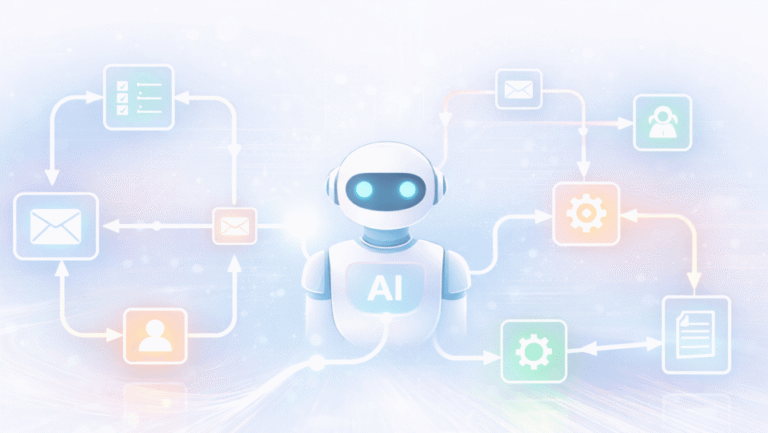
That is why AI works best as a component inside a larger workflow rather than the workflow itself.
Its strengths lie in classification, summarization, extraction, and pattern recognition. Its weaknesses appear when certainty, traceability, and strict control are required. In those cases, rule-based automation should remain in charge.
But there are plenty of ways to incorporate AI into workflow to supercharge them, streamline bottlenecks, and remove the need for human intervention.
Example 1: AI-Assisted Intake Routing with CRM Integration
Consider an incoming website form submission. Some submissions are new sales inquiries. Others are existing customers asking for support. Some may be partnership requests. A few may not clearly fit any predefined category.
A rules-only system might route based on a dropdown field. But users often select the wrong option or reveal through their notes that that their intent may differ.
This is where AI adds value, especially when integrated with a CRM.
Workflow concept:

In this scenario, AI interprets the intent behind the message. It may detect whether the inquiry is sales-related, a support escalation, or a billing issue. At the same time, the workflow checks the CRM to determine whether the sender is an existing customer, an open opportunity, or a new lead.
Based on this combined context, the system can:
- Create a new lead in the CRM
- Attach the submission to an existing contact or account
- Update an opportunity stage
- Assign the record to the correct sales or support owner
- Escalate high-priority cases automatically
AI handles the interpretation of the unstructured text. The CRM integration and rule-based logic enforce structure, ownership, and data integrity.
If the AI confidence score falls below a defined threshold, the workflow routes the submission for manual review instead of acting automatically. Rules still govern record creation, assignment logic, and escalation paths, but the need for human oversight is reduced to only when needed.
Example 2: AI-Driven Content Generation Inside a Structured Workflow
Automating content generation is a great way to improve productivity when the there are clear guidelines and instructions for what should happen and when.
A marketing team may need to generate product descriptions, email drafts, or social posts at scale. The structure of the workflow is predictable: new product added, content required, draft created, review approved, content published.
The creative step, however, cannot be fully scripted with deterministic logic. This step requires and understanding on the input before the content can be generated based on pre-defined instructions.
The AI enhanced workflow may look like:

AI accelerates the drafting process by generating content from structured inputs such as product features, target audience, and brand tone guidelines. But the workflow still enforces constraints. Required fields must be present. Length limits must be respected. Approval steps remain intact. This allows the work to happen in the background, while still including a human element, but only after the initial work has been completed. This workflow can run at scale drastically cutting down the time needed to generate assets.
Fit the Technology to the Need
AI does not replace structured automation but it can enhance it’s capabilities.
In most cases, simple is better. When rules can handle the task, they should. Deterministic logic is faster, more predictable, and easier to control. If a workflow simply moves data, applies conditions, or triggers actions, rules are enough.
However, rules have their limits and can be ridgid. When a workflow requires interpretation, analysis, pattern recognition, or content generation, strict logic falls short. That is where AI adds real value.
If you would like to learn more about workflow automation or if you have processes you’d like to explore automating, contact Arc Intermedia to explore what automations can do for your business.