



If you work in marketing or communications, the last couple of years have probably felt a bit chaotic. Between the rapid rise of AI search tools like Gemini, Perplexity, ChatGPT, and the massive generative overhauls we’re seeing from Google, the lines between different departments are blurring.
Suddenly, the SEO team is asking for media mentions, the PR team is trying to figure out how to write for LLM (Large Language Model) crawlers, and content writers are caught somewhere in the middle. Because everyone is fighting for the same digital real estate and AI citations, it’s easy to assume that digital marketing, content writing, Answer Engine Optimization (AEO), and Public Relations (PR) have all merged into one single discipline.
But conflating them is a massive strategic mistake. They might be sharing the same sandbox, but they operate under entirely different mechanics, motivations, and human philosophies.
1. The Core Split: Intent and Mechanics
To understand why these fields remain so different, we have to look at what drives the creation of a message and how it actually reaches an audience.
Digital Marketing, Content Writing, and AEO
For sake of discussion, think of this as an algorithm-first, demand-capture system. When someone goes to an AI search engine and types a specific question, they have immediate intent. Content marketing and AEO are built to feed beautifully structured, direct data to machines so that your brand is the one chosen to answer that query. It is clinical, highly tactical, and transactional. You are providing the exact puzzle piece a machine is searching for (which should mean it’s also what humans are searching for).
Public Relations (PR)
PR is a human-first, trust-building mechanism. It doesn’t wait for a user to type a prompt or an algorithm to crawl a page. Instead, PR introduces completely new narratives into the cultural and media ecosystem. It relies on deep relationship-building with journalists, editors, and industry gatekeepers to earn credible, third-party validation. If marketing is about answering the questions people are already asking, PR is about changing the conversation entirely.
2. A Real-World Comparison
To look at it plainly, the structural boundaries of these disciplines remain entirely separate:
The Main Target: Content marketing and AEO target algorithms, AI scrapers, and intent-driven users. PR targets only people, specifically journalists, editors, and the broader public.
The Gatekeeper: For digital marketing, the gatekeeper is mathematical code and vector databases. For PR, it is human editorial judgment and real-world news relevance.
The Nature of the Writing: AEO writing is direct, factual, and strictly structured for easy data extraction. PR writing is emotionally engaging, timely, and focused on storytelling or following trends.
Control Over the Message: Marketing offers high control; you own your blog and you can buy exact sponsored placements. PR offers very low control; a journalist decides the final spin of an article, or if they even want to mention your brand at all.
The Core Metrics: Marketing measures conversions, click-through rates, and citations. PR measures brand sentiment, unique voice, and overall reputation.
3. Why the Architecture of Your Text Matters
The difference becomes incredibly clear when you look at how text is actually written for each discipline. Let’s use the smart home energy management industry as a perfect example of this split.
Content written for digital marketing and AEO prioritizes ease of extraction. For example, an optimized marketing phrase might read: “Smart home energy monitors reduce residential electricity bills by automatically adjusting HVAC settings during peak-load hours, saving homeowners an average of 22% annually.” It’s direct, factual, and easily categorized by a scraping bot looking to answer a “how to save money on electric bills” query. It’s also, of course, helpful for humans.
PR storytelling, however, relies entirely on human context and emotional hooks. A PR pitch for that exact same smart energy company would focus on a broader, timelier narrative: “As municipal power grids face unprecedented strain from extreme summer heatwaves, neighborhood communities are taking energy conservation into their own hands. Here is how a small suburb in Texas banded together to prevent a local blackout using collective smart-meter tracking.”
An AI bot cannot easily turn that emotional community narrative into a quick, 10-word summary box for a hardware product query. However, a human editor might publish it because it connects deeply with a timely, real-world issue their readers care about.
4. The Modern Blueprint: How Agencies Write for Major LLMs
Because AI models do not read like humans, they process text based on mathematical probability and pattern retrieval. Forward-thinking agencies, like Arc Intermedia, have shifted from traditional copywriting to what is known as Generative Engine Optimization (GEO). Agencies are changing the actual structure of text for better discovery by major AI models.
Injecting “Information Gain”: LLMs are trained to penalize repetitive, AI-generated fluff. Modern agencies conduct primary interviews with internal Subject Matter Experts (SMEs) to inject entirely unique data points, proprietary case studies, and original frameworks into articles. These original thoughts act as a magnet for AI scrapers looking for non-commodity information.
Magnetizing Citations: Research shows that AI engines frequently pull citations from the introductory sentences of a text block. Because of this, agencies commonly lead with the definitive answer and use subsequent paragraphs only for elaboration.
Optimizing for Retrieval-Augmented Generation (RAG): When an AI tool answers a question, it queries the live web to find a consensus. Agencies use precise semantic headers and short, two-to-three-sentence paragraphs. Breaking text into clean, bite-sized blocks makes it exponentially easier for AI databases to index and recall the information.
5. The Search Overhaul: Why This Matters Right Now
The distinction between structured content and human authority has become incredibly high stakes. Google’s recent major updates have turned search from a list of simple blue links into an intelligent, conversational system powered by AI. With background search agents actively crawling the web 24/7 on behalf of users, the landscape has fundamentally changed.
First, we are living in a zero-click reality. Google is increasingly answering complex questions, analyzing files, and synthesizing data entirely within its own interface. If a brand’s content is not perfectly optimized for extraction, it’s unlikely to be referenced by these background search agents.
Second, because AI models have to combat an overwhelming wave of automated web spam, they are trained to rely heavily on trusted publications, premium journalism, and real-world authority. High-quality PR is now the primary fuel for digital visibility. If a brand does not have human-vetted, earned media mentions across major publications, AI information agents could eventually look right past it.
6. Why You Need an Agency Partner to Tie it Together
Because the digital landscape has become so complex, trying to manage these channels in isolation or handling them entirely in-house without specialized expertise often leads to frustration. This is where a cross-functional agency partner becomes invaluable.
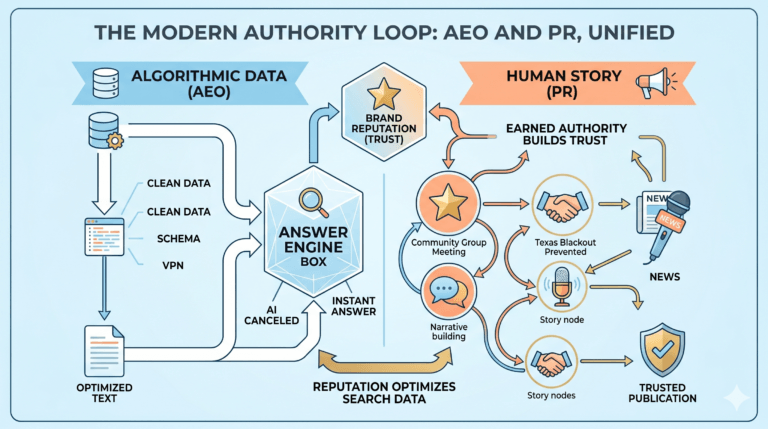
An agency bridges the gap between these distinct disciplines, turning them into a cohesive authority loop:
PR secures the raw authority: The agency’s PR arm pitches human journalists and lands high-profile, earned media coverage in trusted publications.
Marketing creates the digital infrastructure: The agency’s digital marketing and AEO teams take that real-world credibility, package it using proper semantic formatting, and ensure it is easily readable for modern AI search engines.
Unified Strategy: An agency ensures that content writers are not writing in a vacuum, and PR teams are not chasing stories that offer zero digital value. They align human storytelling with algorithmic data requirements.
In a search environment governed by background agents and generative answers, digital marketing and AEO lay the technical groundwork, while PR builds the public trust required to pass the algorithm’s filters. Managing both sides of this coin is exactly what allows a modern agency to keep a brand visible, credible, and successful.


