


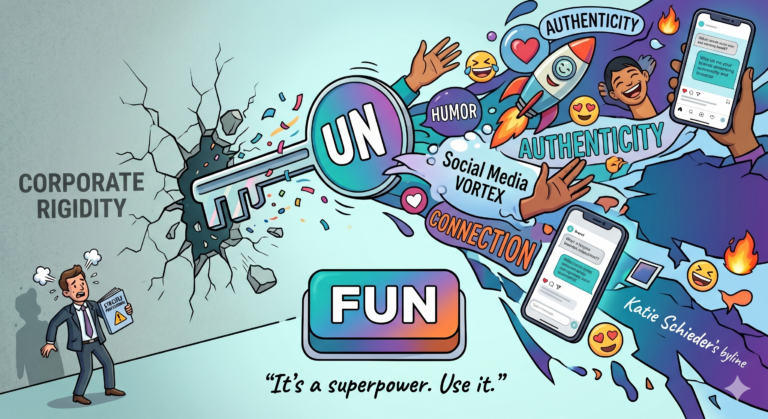

There is a persistent myth in the corporate world that professionalism must be synonymous with a clinical lack of humor.
For years, the prevailing wisdom suggested that to be taken seriously, a brand’s social media presence needed to be polished, predictable, and entirely risk-averse. We were taught that authority was built through distance and a strictly formal tone.
But in the modern digital landscape, that distance is often interpreted as a lack of authenticity. People do not log onto social media to read dry white papers or interact with a faceless corporate entity. They want to be entertained! To connect. To find moments of genuine resonance.
Quit Messing Around
When a brand allows itself to have fun, it’s not simply “messing around.” When the brand humanizes itself in a way that traditional advertising can’t replicate, the relationship moves from a one-way broadcast to a two-way conversation.
The power of humor and play is connected to how our brains process information and build loyalty. When we laugh or find something clever, our bodies release dopamine, which creates an immediate positive association with the source of that feeling. For a brand, this transition is vital, because it shifts your identity from being a mere vendor to being a personality with a perspective.
The data consistently supports this shift in consumer expectations:
- Recent industry reports, including the Oracle Happiness Report, have found that an overwhelming 91% of people prefer brands to be funny
- Yet nearly 95% of business leaders admit they are afraid to use humor in their marketing
This massive disconnect represents a significant opportunity for brands willing to bridge the gap and show a more relatable side of their business.
Take the Leap
Stepping out of the corporate comfort zone requires a calculated leap of faith, but it does not mean every company needs to pivot toward slapstick comedy or chase every fleeting internet meme.
True brand “fun” is found at the intersection of your core values and your audience’s unique sense of irony or shared experience. It involves finding the “human” in the technical. Even the most specialized industries have internal jokes and shared pain points that, when highlighted with a light touch, signal to your customers that you truly live in their world.
On platforms like TikTok or Instagram, “vibe” and personality often outweigh high-production value. Low-fidelity, high-personality content frequently outperforms million-dollar commercials, because it feels like it was made by a person rather than a committee, and that relatability is the ultimate currency of social media engagement.
Protect Yourself
Of course, this approach requires a set of internal guardrails to ensure that fun never devolves into recklessness. The goal is to be the life of the party, not the guest who fails to read the room.
Effective brand humor requires high contextual awareness, ensuring that lightheartedness never comes at the expense of a customer’s genuine problem or occurs during sensitive global events. It is about being agile and participating in real-time cultural moments while remaining anchored to who you are as a company.
At Arc Intermedia, we have always championed a human-centric approach to digital strategy, operating under the belief that marketing should be as enjoyable as it is effective. We treat our clients’ brands with incredible care, but we also recognize that a brand capable of laughing at itself is a brand that people actually want to follow and support. The Barbie movie lampooned Mattel and its CEO, and rejuvenated the brand in the process.
Ultimately, if a social media feed feels like a series of digital brochures, it isn’t just being “safe”—it is being irrelevant. In an era where attention is the scarcest resource available, being boring is the greatest risk of all.
Social media remains the only medium where a global corporation can trade a joke with a customer in the comments section, breaking down the traditional walls of commerce to build something more enduring. By stepping out of the comfort zone and embracing a more playful, transparent voice, you’ll likely boost your engagement metrics, and you may even build a community that feels seen and appreciated.
It’s time to stop fearing the “fun” and start leveraging it as the superpower it truly is.
Don’t Worry, Be Silly
Want an example? Look at this reel I made for the Arc Instagram. It’s certainly not perfect, in fact it has an audio mistake that makes me sound less like a marketing director and more like a mouse – but I kept it in. Why? Because it’s a little funny. It’s memorable. It’s certainly less polished than the buttoned up content we place on the website. And more importantly? Its authentic.
Press play. I promise not to dance, but I also promise that the lack of polish, not-so-precisely curated verbiage, and less than perfect editing will stick with you longer than an AI video.
Start Having Fun
Embracing this shift doesn’t require an overnight overhaul of your entire corporate identity, but it does require a willingness to experiment and a partner who understands how to balance wit with wisdom.
The brands that win in the next era of digital connection will be those that prioritize personality over perfection and engagement over ego. If your current social strategy feels more like a monologue than a conversation, it might be time to rethink your approach and find the fun that resides within your brand’s DNA.
Is your brand ready to start the conversation? Reach out to our team today to see how we can help you find your unique voice, engage your audience more authentically, and turn your social media presence into a platform for genuine connection.


