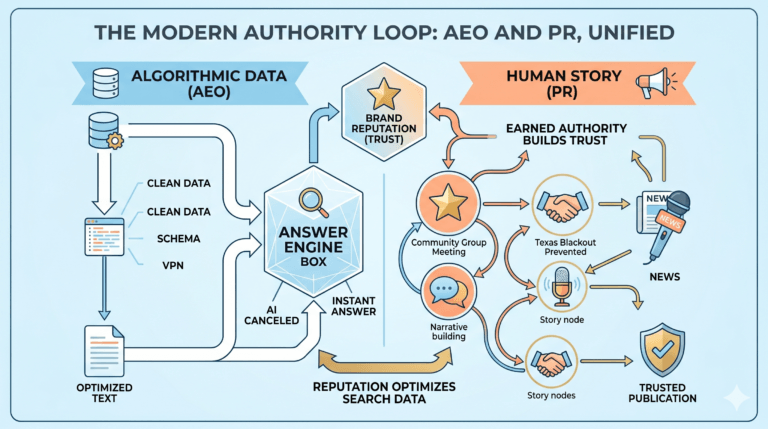



AI-powered search is rewriting the rules of visibility. Traditional SEO tactics alone no longer guarantee that your brand will show up in ChatGPT, Google’s AI Overviews, Perplexity, or Claude. Yet many brands (and even some agencies) are still approaching AI search with outdated assumptions that are costing them visibility, authority, and ultimately, revenue.
Traditional SEO vs. AI Optimization: What’s the Difference?
Traditional SEO services focus on ranking web pages in search engine results to drive clicks, relying heavily on keywords, backlinks, and technical optimization. In contrast, AI optimization is about getting your brand included in AI-generated answers, where visibility doesn’t depend on ranking but on being recognized as a trustworthy source.
AI optimization prioritizes clear, answer-focused content, strong brand authority, and presence across multiple platforms, because AI tools pull from a wide range of sources to generate responses, not just the top search results.
While there is overlap between effective SEO and AI optimization tactics, a purely SEO strategy can have negative consequences. If your brand isn’t being surfaced in AI-generated answers, chances are your strategy isn’t aligned with how these systems actually work.
Let’s break down the most common reasons AI search visibility strategies fail, and what to do instead.
1. You’re Treating AI Search Like Traditional SEO
One of the biggest mistakes is assuming AI search engines retrieve and rank content the same way as Google’s traditional algorithm.
They don’t. Just because you see a lot of the links being cited in AI also ranking in Google doesn’t mean they correlate
AI systems don’t just “rank pages.” What they’re actually doing is synthesizing answers, which means:
- They prioritize context, clarity, and completeness
- They pull from multiple sources, not just top-ranking pages
- They favor entities and trusted brands, not just keywords
If your strategy is still focused purely on:
- keyword density
- backlinks
- ranking #1 for a term…
…you’re optimizing for the wrong outcome. This fails because AI doesn’t need the best page. It needs the best answer.
2. Your Content Isn’t Structured for Retrieval
AI models rely heavily on structured, scannable, semantically clear content. If your content marketing efforts are messy, vague, or overly bloated, they’re less likely to be selected.
Common issues include:
- Long paragraphs without clear subtopics
- Lack of headings that match user intent
- No direct answers to specific questions
- Buried key information
This fails because AI systems extract concise, well-organized insights. If your content is hard to parse, it gets ignored, even if it’s technically “good.”
3. You’re Not Building Topical Authority
AI search engines prioritize subject-matter authority, not just isolated content pieces.
Many brands create:
- a few blog posts
- scattered landing pages
- disconnected content…
…but never build a cohesive topical footprint.
This fails because AI systems look for patterns. If your brand only shows up sporadically on a topic, it won’t be considered a reliable source.
4. You Ignore Brand Signals
AI search is increasingly brand-driven.
If your brand:
- isn’t mentioned across the web
- lacks consistent positioning
- doesn’t appear in trusted sources…
…it’s far less likely to be cited or referenced in AI-generated answers.
This fails because AI models are trained to prioritize recognized entities. Unknown or weak brands rarely get surfaced, even if their content is solid.
5. You’re Not Optimizing for Conversational Queries
AI search thrives on natural language. Users aren’t just typing keywords—they’re asking full questions.
Example:
- Old search: “best retirement communities Florida”
- AI search: “What are the best retirement communities in Florida for active adults under $500k?”
If your content doesn’t match:
- question-based queries
- long-tail intent
- conversational phrasing …
…it won’t align with how AI retrieves answers.
This fails because AI systems match meaning, not just keywords.
6. You Focus Only on Your Website
Another major blind spot: assuming your website is the only thing that matters.
AI engines pull from:
- third-party articles
- directories
- forums
- reviews
- press mentions
If your brand isn’t present across these ecosystems, you’re invisible in the broader data landscape.
This fails because AI answers are built from the entire web, not just your domain.
7. You Don’t Measure AI Visibility
Most companies are still tracking:
- keyword rankings
- organic traffic
- click-through rates
But AI search changes the game:
- Users may never click your site
- Your brand might appear in answers without attribution
- Visibility becomes presence, not position
Why this fails: If you’re not measuring:
- brand mentions in AI answers
- citation frequency
- inclusion in summaries…
…using an AI visibility platform, you don’t know if your strategy is working.
What Strategies Improve Brand Visibility in AI Search Engines?
To succeed in AI search, you need to shift from ranking content to becoming a trusted, retrievable source of truth.
Here’s what actually works:
1. Create Answer-First Content
Structure your content to directly answer questions:
- Use clear headings that mirror user queries
- Provide concise, authoritative responses upfront
- Follow with deeper supporting detail
Think:
- “What is…”
- “How does…”
- “Best way to…”
This aligns perfectly with how AI extracts information.
2. Build Topic Clusters, Not Isolated Pages
Instead of single posts, develop content ecosystems:
- Core pillar pages
- Supporting articles
- FAQs and subtopics
This signals depth and authority—key factors in AI retrieval.
3. Strengthen Your Brand Entity
Make your brand recognizable across the web:
- Consistent messaging and positioning
- Mentions in reputable publications
- Presence in industry directories
- Strong “About” and author credibility signals
AI models are far more likely to cite known entities.
4. Optimize for Multi-Platform Visibility
Expand beyond your website:
- Publish on high-authority platforms
- Contribute guest content
- Leverage PR and earned media
- Engage in forums and Q&A spaces
The more places your brand appears, the more data AI has to pull from.
5. Use Clear, Structured Formatting
Make your content easy to extract:
- Bullet points and numbered lists
- Short paragraphs
- Defined sections
- Schema markup where applicable
Clarity is good UX, and it’s critical for AI parsing.
6. Target Conversational and Long-Tail Queries
Create content that mirrors real questions:
- Use natural language
- Include variations of queries
- Address specific use cases
This increases the likelihood your content matches AI prompts.
7. Monitor and Adapt to AI Search Behavior
Track how your brand appears in AI tools:
- Ask relevant queries in ChatGPT, Perplexity, etc.
- Analyze which competitors are cited
- Identify gaps in your content
AI search is evolving quickly—your strategy should too.
AI search visibility isn’t about gaming an algorithm. If your strategy is failing, it’s likely because it’s still rooted in old SEO thinking. The brands that win in this new landscape will be the ones that:
- prioritize clarity
- build authority
- show up everywhere
- think like a source, not just a publisher
That’s the shift, and it’s already underway.
Curious what real AI search visibility growth looks like? See how we helped a retirement community network significantly increase its presence across AI-powered search platforms in this detailed case study.